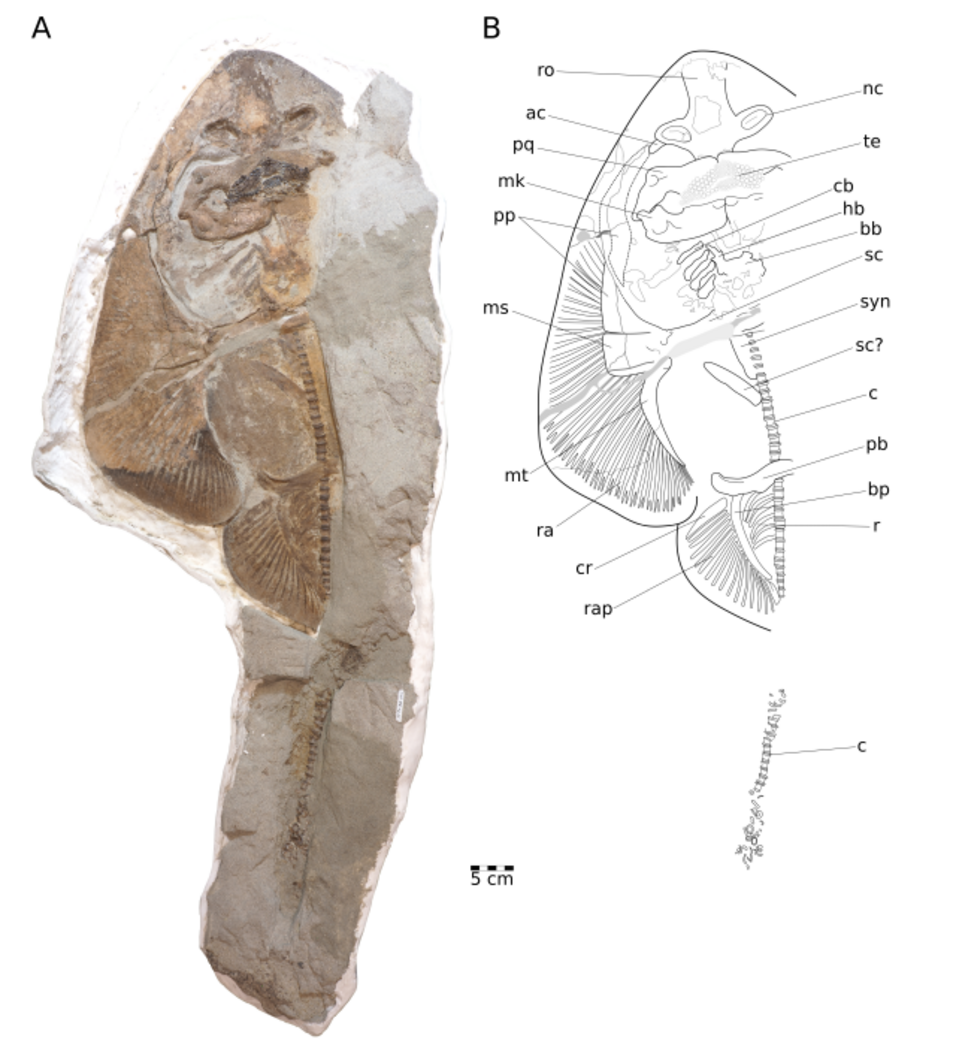
Usually, only the teeth of extinct sharks and rays are preserved because their skeletons are made of cartilage, which rarely fossilises. Although numerous tooth finds of Myledaphus bipartitus are known from North America, its exact systematic position remained uncertain for decades. Now, for the first time, a comprehensive study has been conducted on an exceptionally well-preserved, almost complete skeleton from the Late Cretaceous, dating back some 80 to 72 million years. "This specimen provides a glimpse of previously hidden details of the head, fins, and teeth - precisely the information we have long lacked for reliable classification," says lead author Julia Türtscher.
Close relationship with guitarfish and sawfish
The team took high-resolution photographs of the fossil and used UV light to reveal fine structures. Based on these photographs, the researchers compiled a comprehensive morphological dataset and tested the phylogenetic relationships using established phylogenetic analysis methods. "The analyses consistently point to a close relationship with modern guitarfish and sawfish," explains Patrick L. Jambura. "According to our phylogenetic analysis, Myledaphus bipartitus is an early representative of the order Rhinopristiformes, to which guitarfish and sawfish belong." The discovery also confirms the hypothesis that Myledaphus bipartitus inhabited both freshwater and brackish habitats. "The ability to tolerate widely fluctuating salinity levels - euryhalinity - is thus evidenced evolutionarily even earlier than previously assumed," says Jambura.
A stroke of luck for ray palaeontology
The significance of this discovery extends beyond a mere re-evaluation of a single fossil. This ray, which is approximately one metre long and originates from the Dinosaur Park Formation, provides a rare articulated skeleton, which is a stroke of luck for ray palaeontology. "Although teeth can tell us a great deal, only complete skeletons provide the crucial anatomical features needed to truly trace the evolution of modern ray lineages," emphasises Jürgen Kriwet, head of the Evolutionary Morphology Research Group at the University of Vienna's Institute of Palaeontology and co-author of the study.
This discovery fits into a broader context: while most rays nowadays live in the sea, some species, such as sawfish and guitarfish, regularly venture into estuaries and freshwater habitats. Some species are even fully adapted to living in freshwater. There are also examples of repeated, independent "freshwater colonisations" in the past, such as Eocene (around 50 million years old) freshwater stingrays from North America. Myledaphus bipartitus shows that such ecological experiments were already taking place over 70 million years ago. "The fact that we can place Myledaphus bipartitus so clearly within the order Rhinopristiformes suggests that freshwater tolerance evolved early in this group and independently in different ray lineages," summarises Türtscher.
At the same time, the authors interpret their findings as a mandate for the future, given that many Cretaceous ray fossils, such as those found at several sites in Lebanon, have so far been inadequately described. "With every additional well-preserved skeleton, we refine our understanding of the early diversification of modern ray orders," says Kriwet. "It is impressive how much evolutionary history can be contained in a single extraordinary specimen."
Infobox
- The study was carried out by the University of Vienna (Faculty of Earth Sciences, Geography and Astronomy; Vienna Doctoral School of Ecology and Evolution), in collaboration with the Royal Tyrrell Museum of Palaeontology in Canada. The study was funded by the Austrian Science Fund (FWF). The original paper was published in the Journal of Systematic Palaeontology.
- Publication: Türtscher, J., Jambura, P. L., & Kriwet, J. (2026). Skeletal morphology and phylogenetic relationships of the Late Cretaceous freshwater ray Myledaphus bipartitus (Chondrichthyes; Batomorphii). Journal of Systematic Palaeontology, 24(2). https://www.tandfonline.com/doi/full/10.1080/14772019.2026.2679622
Summary
- A nearly complete fossil ray skeleton, measuring 101 cm in length and dating back approximately 80 to 72 million years, has been described in detail. It was originally found in the Dinosaur Park Formation in Canada.
- The combination of both primitive and derived characters supports the classification of Myledaphus bipartitus within the order Rhinopristiformes, which includes modern guitarfish and sawfish.
- Myledaphus bipartitus is the oldest known member of this order that was capable of tolerating freshwater, which is an indication of the early ecological diversity within the group.
- Comparative phylogenetic trees suggest a close relationship with the Rhinopristiformes, although the specifics of these relationships are in some cases still unclear.
- The study highlights the importance of rare fossilised skeletal remains of rays (as opposed to teeth) for understanding their evolution.
Scientific Contact
Dr. Julia Türtscher, BScMSc
E-Mail: tuertscher.julia@gmail
Univ.-Prof. Dipl.-Geol. Dr. Jürgen Kriwet
E-Mail: juergen.kriwet@univie.ac.at
Department of Palaeontology, University of Vienna
https://palaeontologie.univie.ac.at/
https://www.evomorg.org