
Shedding light on the dark universe: New Special Research Area involving University of Vienna
Shedding light on the dark universe: New Special Research Area involving University of Vienna
03.12.2025
Astrophysicists Oliver Hahn and Sylvia Ploeckinger from the University of Vienna are researching dark matter and dark energy as part of the new DUNE special research area. This year, the FWF is funding a total of three new special research areas in the fields of cosmology, medicine and quantum research; the Faculty of Physics at the University of Vienna is also involved in the latter. The new networks, which are coordinated at the Universities of Innsbruck and Salzburg and the Vienna University of Technology, will each receive around 4 million euros in funding over a period of four years.
The Austrian Science Fund (FWF) is funding three new Special Research Areas (SFBs) in cosmology, quantum research and cancer research this year with a combined total of around 12 million euros over the next four years. Oliver Hahn, professor at the Faculty of Earth Sciences, Geography and Astronomy and the Faculty of Mathematics at the University of Vienna, and Sylvia Ploeckinger from the Department of Astrophysics are involved in the new SFB "Dark UNiverse Explorations“ (DUNE), which is dedicated to research into dark matter and dark energy and is coordinated at the University of Innsbruck.

As part of DUNE, observational data – here an image of the galaxy cluster Abell 2390 from ESA's Euclid mission – will be compared with virtual universes to study the dark matter and energy of the universe. Photo: ESA/Euclid/Euclid Consortium/NASA, image processing by J.-C. Cuillandre (CEA Paris-Saclay), G. Anselmi. CC BY-SA 3.0 IGO
Other funded SFBs are dedicated to cancer research (coordinated by immunologist Iris K. Gratz from Paris Lodron University Salzburg) and quantum technology (coordinated by the Vienna University of Technology; the Faculty of Physics at the University of Vienna is also involved, among others).
Special Research Area "Dark UNiverse Explorations (DUNE)"
Im Spezialforschungsbereich „Dark UNiverse Explorations” (DUNE)“ kooperieren Forscher*innen der Universitäten Innsbruck und Wien sowie des Institute of Science and Technology Austria (ISTA). Eines der zentralen Ziele ist es, mehr über die Dunkle Materie und die Dunkle Energie im Universum zu lernen. Zusammen machen diese unsichtbaren Komponenten 95 Prozent des Energiegehaltes des Universums aus, ihre jeweilige physikalische Natur ist aber immer noch weitgehend unbekannt. Weder die Dunkle Materie noch die Dunkle Energie können direkt beobachtet werden. Indirekt hinterlassen sie jedoch Signaturen, zum Beispiel in den Verteilungen und Eigenschaften von Galaxien, sowie in winzigen Verzerrungen der beobachteten Galaxienformen durch den Gravitationslinseneffekt. Der Vergleich von Galaxienbeobachtungen mit theoretischen Modellen kann also Licht ins Dunkle Universum bringen.

The ‘Dark UNiverse Explorations (DUNE)’ SFB team. From left to right: Oliver Hahn (University of Vienna), Laila Linke (University of Innsbruck), Sebastian Grandis (University of Innsbruck), Francine Marleau (University of Innsbruck), Sylvia Ploeckinger (University of Vienna), Tim Schrabback (University of Innsbruck), Jorryt Matthee (ISTA). Photo: private
DUNE uses observational data from the Euclid mission and the James Webb Space Telescope for this purpose. As part of international research collaborations, the DUNE team analyses Euclid data at the University of Innsbruck and observational data from the James Webb Space Telescope at ISTA.
Simulation of ‘virtual universes’ at the University of Vienna
In order to draw conclusions about the properties of dark matter and dark energy, the results of the observations are compared with simulated ‘virtual universes’. These simulations are (co-)developed at the University of Vienna and model cosmic structure formation in these digital replicas of our universe: COLIBRE is a simulation project in which a small number of particularly detailed simulations are carried out. Complementary to this are the simulations from the DISCO project, which can quickly test many different theories using the new Austrian supercomputer MUSICA.

Near the full expanse of the visible universe, the cosmos appears smooth and homogeneous. Hidden in that uniformity are minuscule perturbations seeded by quantum processes in the infant universe; over billions of years, gravity amplifies them into today’s large‑scale structure. As we zoom in, the filamentary cosmic web comes into view—bright nodes are massive galaxy clusters, green tendrils are the filaments that connect them, and the dark regions are vast near‑empty voids. This scene is from a high‑fidelity numerical universe, evolved with 70 billion simulation particles to capture the growth of structure from quantum seeds to cosmic architecture. Using the DISCO-DJ software, such model universes can be simulated in a few seconds, allowing to rapidly compare many model predictions against measurements from telescopes on the ground and in space, such as the Euclid mission. Credit: The DISCO-DJ team (F. List, O. Hahn, L. Winkler, T. Floess, University of Vienna)

Matter in the local universe is arranged in a web-like structure. At the nodes, galaxies, galaxy groups, and massive galaxy clusters take form. The large image shows the distribution of all baryonic matter—stars, gas, and dust—in a simulation from the COLIBRE project. The smaller images display a few examples of the thousands of galaxies that emerge within the simulation. Just as in the observed universe, some COLIBRE galaxies evolve into slender spiral galaxies (e.g., lower left), while others adopt an elliptical morphology (e.g., lower right). Image: (C) COLIBRE Team (www.colibre-simulations.org); Schaye et al. (2025, arXiv:2508.21126)
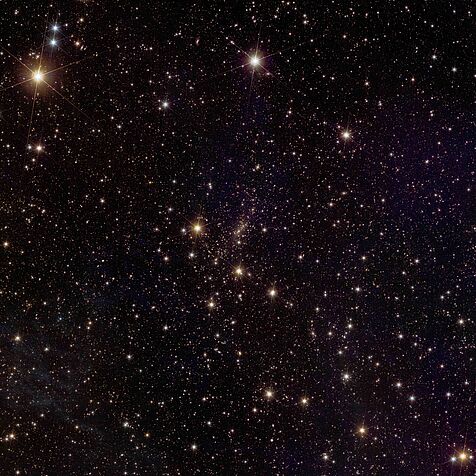
This image is part of ESA’s Euclid Early Release Observations and shows the massive galaxy cluster Abell 2390, located 2.7 billion light-years away. Over 50 000 galaxies are visible, making the cluster a prime site for studying dark matter, which dominates its mass. With its wide field-of-view and combined visible and infrared imaging, Euclid reveals striking gravitational-lensing arcs that trace the cluster’s dark matter distribution, as well as faint intracluster light from stars stripped from their galaxies. These early observations preview Euclid’s upcoming large-scale survey, which will map thousands of clusters to better understand dark matter, dark energy, and the evolution of the Universe. The DUNE research network will make important contributions to the exploitation of these exquisite observations. Image: ESA/Euclid/Euclid Consortium/NASA, image processing by J.-C. Cuillandre (CEA Paris-Saclay), G. Anselmi; CC BY-SA 3.0 IGO
The DUNE special research area opens a new window onto the dark universe for Austria and brings us one step closer to answering the biggest questions in modern cosmology.
The University of Vienna is also involved in the special research area ‘Quantum systems of neutral atoms with high connectivity’, which is coordinated at the Vienna University of Technology (TU Wien), with its Faculty of Physics.
Special Research Areas for cross-institutional cooperation
With its Special Research Area funding, the FWF aims to promote excellent research networks. Austria's research institutions are given the opportunity to firmly establish promising researchers and sharpen their own research profile. Teamwork is a top priority, with up to 15 researchers joining forces in a special research area. The focus is often on multi- or interdisciplinary research topics. A balanced consortium of established researchers and young scientists is also a key concern. The funding programme is financed by the Fonds Zukunft Österreich (Fund for the Future of Austria).
Tackle promising scientific challenges that would be impossible to achieve alone
‘Special Research Areas bring together leading researchers in their field from Austria and beyond to pool knowledge and tackle promising scientific challenges that would be impossible to achieve alone,’ says FWF President Christof Gattringer, who warmly congratulates the newly funded researchers.
In the current round of applications, financed by the Fonds Zukunft Österreich, 23 consortia submitted a concept for international review – five of them were able to submit a full application, and three will now receive funding of around 12 million euros for the next four years.
In addition to the three new special research areas, the FWF is extending funding for the following existing special research areas: ‘Meiosis’ (coordinated at the University of Vienna) and ‘Computer-Aided Electrical Machine Laboratory’ (TU Graz) for a further four years with a total funding volume of € 9.4 million.